Car Theft Protection: Why Rivne Drivers Are Using Aluminum Foil for Key Fobs
Owners of cars with keyless entry systems face risks from 'relay attacks,' but simple aluminum foil can serve as an effective barrier against high-tech thieves.
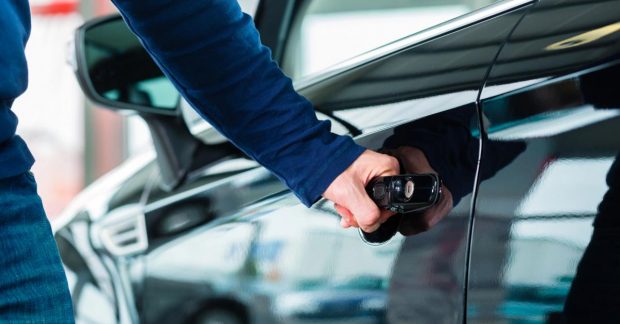 🚨Events
Photo: UNIAN
Key points
- Relay attacks allow car theft by intercepting the key fob signal from a distance.
- Aluminum foil blocks radio signals by creating a Faraday cage effect.
- The key must be completely wrapped in foil without any gaps for effective protection.
Modern convenience technologies, such as keyless entry systems, have brought drivers not only comfort but also new security challenges. In Rivne, where the number of modern imported cars is constantly increasing, the issue of property protection is becoming more relevant. Criminals have learned to exploit vulnerabilities in radio signals, forcing car owners to look for simple yet effective countermeasures. One such method is the use of ordinary aluminum foil.
The main danger lies in so-called 'relay attacks.' A car's key fob constantly emits a weak radio signal that the vehicle recognizes at a short distance. Criminals use special devices to intercept this signal—for example, when the key is inside a house near the front door—and transmit it to a receiver near the car itself. The system 'thinks' the owner is nearby and allows the doors to be opened and the engine to be started without physical contact with the key.
The 'Faraday Cage' Principle in Your Kitchen
The principle behind aluminum foil is based on a physical phenomenon known as the Faraday cage. The metallic layer is capable of blocking electromagnetic fields, preventing the radio signal from escaping the wrapping. Thus, even if a criminal stands with a scanner right next to your pocket or front door, they will not be able to 'see' the key's signal because the metal creates an impassable barrier for the waves.
For effective protection, it is important to follow specific isolation rules. The key must be completely wrapped in several layers of foil, ensuring there are no holes or uncovered areas. Even a small tear in the metallic shell can lead to signal leakage, making the protection useless. Experts advise using this method whenever the car is left for a long period, especially at night in parking lots near residential buildings.
While this method may seem archaic in the digital age, it remains one of the cheapest and most reliable means of physical signal blocking. Rivne residents should remember that car security is a complex of measures. To use the car, one simply needs to remove the fob from the foil, making this method extremely easy for daily use.
Source UNIAN — unian.ua/curiosities/yak-zahistiti-avto-vid-vikradennya-navishcho-z… ↗
Read next
 👥Society
How Much Water to Drink Daily for Healthy Blood Pressure: Cardiologists Advise
Leading medical experts shared the recommended daily water intake amounts required to maintain stable blood pressure levels.
 🏙️City
Rivne hosts final qualifying stage of national chess tournament featuring over a hundred players
The city has launched the fifth and final qualification round for the 'Chess Stars Cup', determining the final participants for the decisive matches in Lviv.
 👥Society
Health benefits of chicory for digestion and liver: Why you should add it to your diet
Experts highlight the health benefits of chicory, rich in inulin and microelements, supporting gut microbiome and liver function.
 🛡️Security
Disappearance of Russian Strategic Bombers and Air Defense Efficiency: Expert Details
During a massive missile strike on Ukraine, three Russian Tu-160 aircraft vanished from radar screens, while Ukrainian air defense successfully intercepted the vast major…
 🏙️City
Living in Golf Balls: The 40-Year Legacy of the Dutch Bolwoningen Experiment
Built in 1984, the unique spherical houses in 's-Hertogenbosch remain a functional example of experimental urban architecture and social housing.
 🛡️Security
Russian Vessel Sparta II Struck by Ukrainian Drones Still Burning in the Gulf of Finland
Firefighting operations are ongoing in Finnish territorial waters aboard the Russian cargo ship Sparta II following a Ukrainian drone strike.